How spatial attention influences iconic memory [Poster]

Abstract
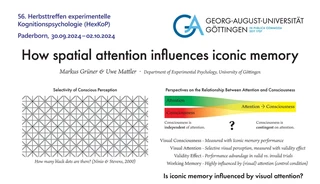
Selectivity is one of the main characteristics of consciousness as well as the defining property of visual attention. Both are considered to be distinct but interrelated processes. However, the relation between attention and consciousness is a subject of ongoing debate. Some argue that attention is a prerequisite for phenomenal consciousness, while others propose the existence of a fleeting, attention-independent phenomenal visual awareness. We investigated the interaction between attention and consciousness using a novel approach that combines spatial cueing with a partial-report iconic memory task (a measure of visual awareness). Participants were briefly presented with multiple arrows and had to report the direction of one, indicated by a colored point presented after varying delays. Preliminary results showed that performance in this task was better after short delays than long delays. Additionally, cues matching the indicator color increased performance when they preceded the to-be-reported arrow at the same location compared to a different position. This cueing effect occurred with short and long indicator delay, suggesting that spatial attention can modulate iconic memory. However, the generally improved performance with short indicator delay indicates that some aspects of iconic memory are independent of visual attention. These findings provide new insights into the interplay between attention and consciousness, helping to distinguish between competing theories and setting the stage for future research.
Date
Sep. 30, 2024 — Oct. 2, 2024
Event
- Herbsttreffen experimentelle Kognitionspsychologie (HexKoP)
Location
In-Person
Paderborn, Germany